Small States, Big Leverage: How Artificial Intelligence Can Rebalance Global Influence
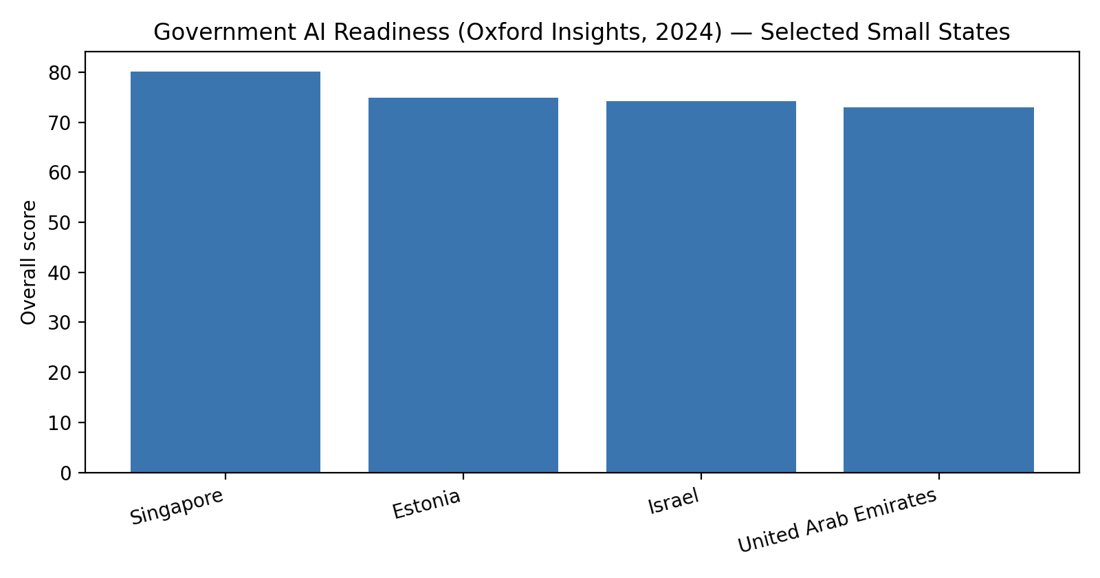
Historically, global influence has been sourced from traditional measures of power: population, geography, industrial capacity, and military mass. Smaller states have typically remained relevant through alliances, niche economic advantages, favorable regulatory environments, or diplomatic agility. Innovation and channeled expertise have given smaller states a chance to make a name for themselves since the beginning of empires, and the next opportunity lies in artificial intelligence. AI lowers the barrier to entry in domains that matter disproportionately in modern competition: intelligence analysis, cyber defense, strategic communications, economic forecasting, and digital governance. In short, AI allows a small state with high human capital and disciplined institutions to punch above its weight.
Key judgments
AI does not make small states “big,” but it can make them harder to ignore. It compresses distance, scales expertise, and turns competent governance into something exportable.
The most durable AI advantage for small states is not a single model or lab. It is institutional speed: the ability to experiment, regulate, procure, and iterate faster than larger bureaucracies.
Small states that combine trusted digital infrastructure, credible AI governance, and targeted talent pipelines can convert reputation into influence: standards leadership, security partnerships, and commercial gravity.
The U.S. will increasingly compete not only against peer adversaries, but for alignment with AI-capable micro-powers. Partnerships will hinge on trust, interoperability, and the ability to help partners manage downside risk.
Four levers that small states pull
In reviewing how smaller nations try to punch above their weight, I kept returning to four levers. Most strategies are some blend of: governance as export, using credible AI assurance, privacy, and standards leadership to become a safe hub for multinational firms and cross-border data flows; digital state capacity, building e-government and secure data exchange as a competitive advantage, because AI is only as useful as the data environment it runs in; talent and compute as national infrastructure, treating compute, research funding, and immigration policy like strategic assets; and security signaling, aligning AI capability with defense modernization and trusted-partner status.
Singapore: standards, scale, and the credible hub play
Singapore’s AI strategy mirrors its history: a colonial breakout with few resources that became an innovation hub by out-organizing everyone it could not outnumber. The government has consistently treated technology policy as statecraft, establishing trust, defining rules clearly, and becoming attractive to private investment. That matters because AI is not just a tech story; it is a confidence story. Firms deploy sensitive systems where they trust the rules, the regulators, and the operating environment.
Singapore’s launch of the AI Verify Foundation is a good example of the governance-as-export model. The premise is simple: if you can build a credible, user-friendly way to test AI for risks and performance, you can shape what “responsible AI” means in real application. A small country can’t dominate markets by brute force, but with consistent vision it can become the referee, and the referee writes part of the rulebook.
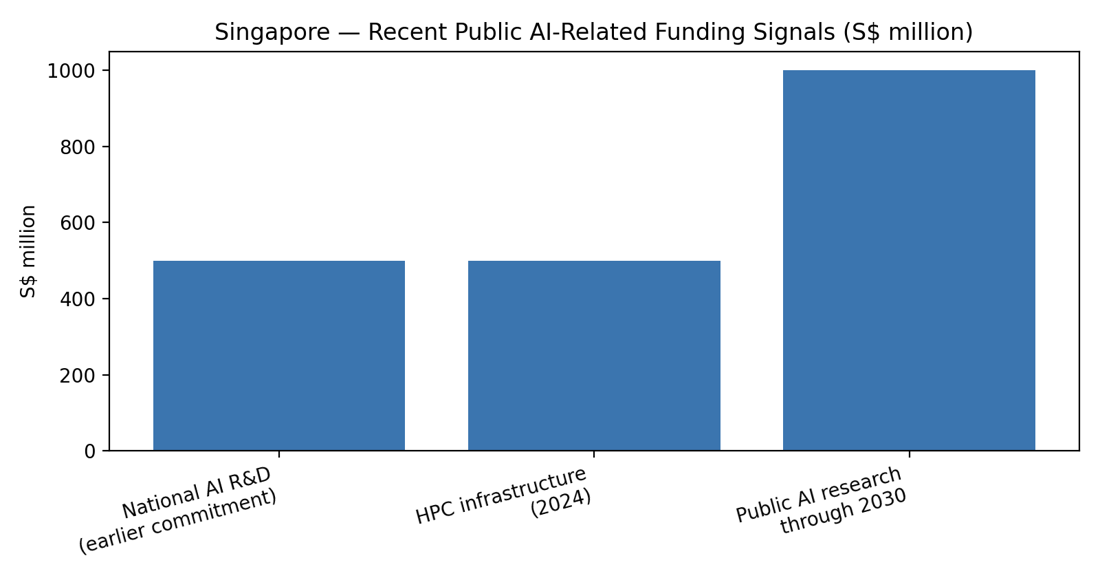
It is not just idealism. In January 2026, Reuters reported Singapore would invest over S$1 billion in public AI research through 2030, building on earlier spending including high-performance computing infrastructure. I find it significant that the start date is immediate, at a moment when many nations publish enormous intent figures on vague timelines. That is a pattern I keep noticing: small states gain leverage when they make themselves predictable: steady rules, steady funding, steady competence.
My finding, and I’ll own it: Singapore’s most strategic AI move is not a single program. It is the alignment between a strong regulatory reputation, regional relevance, and a willingness to invest in the boring but essential mechanisms: compute, talent pipelines, and frameworks that make AI deployable at scale.
Estonia: digital infrastructure as a force multiplier
Estonia is the classic case of small country, big system. Its formula is not flashy projection; it is a quiet, mature digital-government stack that treats identity, services, and data exchange as national infrastructure. In practical terms, Estonia built the interoperable environment AI systems need in order to be useful. A country that cannot securely move data between agencies will struggle to do AI at any meaningful scale.
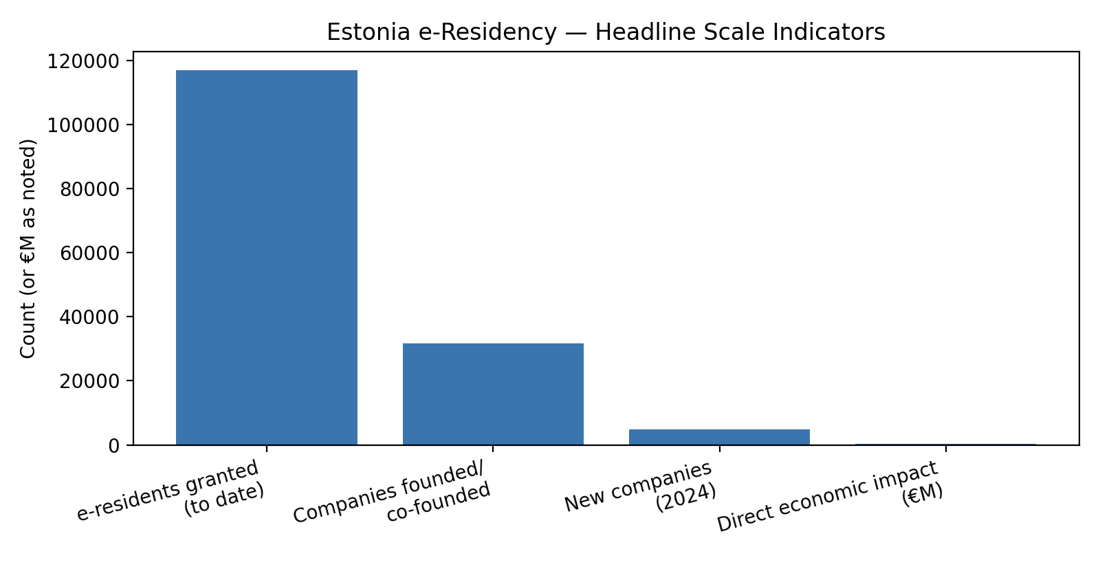
The e-Residency program is where this becomes geopolitically interesting: Estonia has effectively turned part of the state into a product, a legal and digital platform foreign founders can plug into. The numbers are not trivial. Invest in Estonia reports 117,000 e-residents from 185 nationalities and more than 31,800 companies founded or co-founded by e-residents, with direct economic impact of roughly €244M since launch. Estonia’s population is about 1.36 million, a sixth of metro Washington, D.C., yet it has attracted founders from nearly every nation on the planet. A country facing declining birth rates found an alternative way to grow: scale the network.
The piece that deserves more attention is that AI makes Estonia’s platform play more powerful. Digital states are no longer about convenience. They become nodes in global business, compliance, and security ecosystems. A state that can reliably verify identities, run digital services, and maintain continuity, including through concepts like data embassies, becomes disproportionately valuable to partners in a world where cyber disruption is normal.
Implications for U.S. decision makers
If I were advising senior decision-makers, I would frame this as a partnership competition. The U.S. benefits when small but capable states align with democratic norms and interoperable technology ecosystems. Consider the famous 2005 exercise in which a Swedish diesel submarine locked onto a U.S. carrier undetected, exposing a real vulnerability within a controlled environment. Alignment is not automatic; it is earned through consistent engagement and practical support.
In concrete terms: if the U.S. wants to maintain influence in a world where AI capability becomes a diplomatic currency, it should treat small-state AI ecosystems as strategic terrain. They will not replace major powers, but they can easily become the trusted routing points and standards hubs, cyber partners, regional training centers, and legal jurisdictions that shape global deployment.
My takeaway: in the AI era, the web of influence is no longer rooted primarily in geography, industrial might, or conventional armies. It is in networks, platforms, and trust, and small states can build those faster than most people expect. AI does not erase the realities of population and geography, but it does rebalance how influence is accumulated. Singapore and Estonia each show a different way to scale. The common thread is intentionality: AI is not a tech trend, but a long-term instrument of national power.
I keep coming back to subjects like this one because they reward patience. Small states win by being deliberate, and I like the slow work of building an argument from evidence.
Oxford Insights, Government AI Readiness Index 2024.
Personal Data Protection Commission (Singapore), “Launch of AI Verify Foundation,” June 2023.
Reuters, “Singapore to invest over $779 million in public AI research through 2030,” January 2026.
Singapore GovTech, Smart Nation 2.0 initiatives, December 2024.
Invest in Estonia, “Estonian e-Residency attracts record interest and revenue in 2024.”
Statistics Estonia, “One in five e-residents register a business in Estonia,” November 2020.
The Baltic Times, “New milestone for e-Residency,” February 2025.